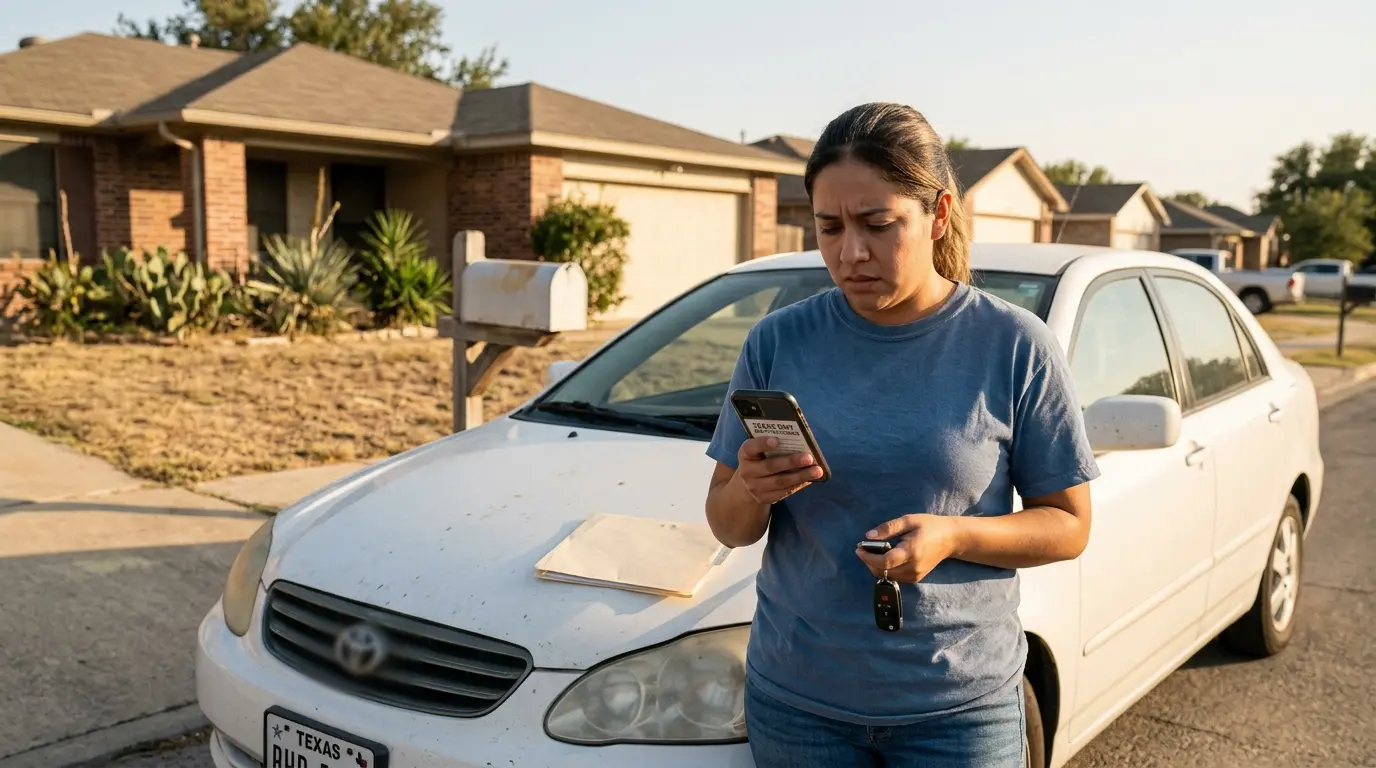
If you bought a car without title in Texas, you may have a serious paperwork problem, but that does not always mean you have no path to ownership. Texas has procedures for situations where a buyer receives incomplete or incorrect ownership documents and cannot obtain the proper title from the seller.
Your first priority should be determining why the title is missing. The next steps can be very different if the seller simply forgot to provide it, the vehicle has an unresolved lien, the title was lost, or the ownership records do not match your purchase documents.
First, Find Out Why You Do Not Have the Title
Before applying for anything, contact the seller and ask for the missing title. If the seller still has the Texas title, completing the normal title transfer is usually much simpler than trying to establish ownership through an alternative process.
TxDMV advises buyers to complete the title transfer within 30 days of purchase. It also warns buyers not to leave a private-party sale without the title.
If the seller says the title was lost, ask whether they can obtain a replacement. If they claim the title is being held by a lender, there may be a lien that must be addressed before ownership can be transferred.
Check Your Purchase Documents
Gather everything connected to the transaction, including:
- Bill of sale
- Purchase agreement or sales contract
- Receipt or invoice
- Cancelled check or payment record
- Seller’s contact information
- Vehicle identification number, or VIN
- Any previous title or registration documents
- Insurance records
- Written communication with the seller
These documents may become important supporting ownership evidence if you cannot obtain a normal title.
Check the Vehicle and Ownership Record
A VIN check can help you identify potential problems before you spend more money on the vehicle.
Look for inconsistencies involving the VIN, vehicle description, ownership information, or recorded liens. A title problem can become more complicated if the vehicle has an outstanding lien, was previously branded, or has an ownership history that does not match what the seller told you.
TxDMV specifically recommends checking the title and vehicle records before buying and emphasizes the importance of receiving the title during a private sale.
If you are in Houston, Texas, this is especially important before assuming that a bill of sale alone gives you everything needed for registration. Houston-area buyers should still follow the same statewide TxDMV title requirements and work through the appropriate county tax office or TxDMV Regional Service Center when required.
What If the Seller Failed to Provide the Title?
Try to resolve the issue with the seller before starting a more complicated title process.
Ask the seller to:
- Provide the original title.
- Correct any errors on the title documents.
- Obtain a replacement title if the original was lost.
- Provide lien-release documentation if applicable.
- Complete the required ownership paperwork.
Save proof of every effort you make to reach the seller. If the seller refuses to cooperate or cannot be located, your available options depend on the vehicle’s records and the evidence you have. A car bought without a title is not automatically eligible for a bonded title. TxDMV reviews the circumstances and documentation before determining whether you qualify.
When Can You Use a Bonded Title in Texas?
A bonded title can be an option when you have incomplete or incorrect evidence of ownership and cannot obtain the necessary documentation from the seller.
To qualify for the bonded title process, TxDMV states that you generally must be a Texas resident or military personnel stationed in Texas. The vehicle must also be in your possession and cannot be junked, nonrepairable, or otherwise ineligible for a Texas title. It must be a complete vehicle with the required major components.
This makes the bought vehicle no title Texas situation more manageable when the normal title-transfer route is no longer available.
Step 1: Apply for Eligibility
You begin by submitting the Bonded Title Application or Tax Collector Hearing Statement of Fact, Form VTR-130-SOF, to a TxDMV Regional Service Center.
The application requires a $15 administrative processing fee and supporting ownership evidence. Depending on the situation, this can include a bill of sale, invoice, cancelled check, or other documentation. Government-issued photo identification is also required.
Step 2: Address Any Recorded Lien
A recorded lien can significantly affect the process.
If the vehicle has a lien that is less than 10 years old, TxDMV requires an original lien release or letter of no interest from the applicable lienholder. If you cannot obtain the required release, you are not eligible for the standard bonded title process based on that unresolved lien. TxDMV notes that a court order may be necessary in such circumstances.
Do not assume that a bill of sale overrides a lender’s ownership interest.
Step 3: Purchase the Required Surety Bond
If TxDMV approves your application, it issues a Notice of Determination showing the amount of the surety bond required.
The bond amount is 1.5 times the vehicle’s determined value. TxDMV generally uses its Standard Presumptive Value first. If that value is unavailable, other valuation sources or an approved appraisal may be used.
For example, if TxDMV determines that a vehicle’s value is $10,000, the required bond amount would be $15,000. This is the bond amount, not necessarily the amount you pay for the bond itself.
You have one year from the date of the Notice of Determination to purchase the surety bond. After purchasing it, TxDMV requires the bonded-title application to move forward within the specified timeframe.
What Happens When You Apply for the Texas Title?
After purchasing the surety bond, you must submit the required documents to the appropriate county tax assessor-collector’s office. This includes the Application for Texas Title and/or Registration, Form 130-U, along with the applicable bonded-title paperwork and supporting documents. If the vehicle has no Texas record, an additional law-enforcement VIN inspection on Form VTR-68-A may be required. This inspection is performed by an authorized law-enforcement officer, not by TxDMV itself.
For a buyer in Houston, the key point is that being in Harris County does not create a separate bonded-title system. The process remains governed by Texas requirements, with the appropriate local tax office and TxDMV Regional Service Center handling their respective parts.
What If a Bonded Title Is Not Your Option?
Not every missing-title situation can be fixed through Texas’s bonded-title process. Depending on the circumstances, you may need a Tax Assessor-Collector Hearing or another legal route to establish ownership. TxDMV specifically identifies the bonded-title process and Tax Assessor-Collector Hearing as options when proper title documents cannot be obtained.
If the vehicle has a significant ownership dispute, an unresolved lien, conflicting ownership records, or other legal complications, getting professional legal advice may be appropriate.
A Practical Checklist for Texas Buyers
If you already purchased a vehicle without its title, do not keep driving forward with missing paperwork and hope the problem resolves itself.
Use this checklist:
- Contact the seller and request the title.
- Ask whether the title was lost, held by a lender, or never transferred.
- Gather your bill of sale and all payment records.
- Record the VIN and check the vehicle’s ownership information.
- Determine whether a lien is recorded.
- Keep evidence showing your attempts to contact the seller.
- Contact a TxDMV Regional Service Center if normal title transfer is not possible.
- Determine whether you qualify for a bonded title or hearing.
- Complete the required forms and inspections.
- Complete the final title and registration steps with the correct Texas office.
iBuy Vehicles can also be a resource for Texas vehicle owners who need to understand their options around vehicles with complicated title situations, but buyers should resolve ownership documentation through the proper Texas process rather than relying only on a bill of sale.
Frequently Asked Questions
Can I register a car in Texas without a title?
Generally, you need acceptable ownership evidence to title and register a vehicle. If the seller never hands over proper title documents, you may need to pursue another Texas ownership remedy, such as a bonded title or a Tax Assessor-Collector Hearing.
Does a bill of sale prove vehicle ownership in Texas?
A bill of sale can be useful supporting evidence, but it does not automatically replace a Texas certificate of title. TxDMV lists a bill of sale and other documents as possible supporting ownership evidence during the bonded-title process.
What if the seller cannot be found?
If you cannot contact the seller and cannot obtain the proper ownership documents, you may be able to pursue a bonded title or another title remedy. Your eligibility depends on the vehicle’s records, condition, liens, and the evidence available to you.
How much time does Texas give you to transfer a vehicle title?
After buying a vehicle in Texas, the buyer usually has 30 days to apply for the title. Waiting can result in penalties, so start addressing a missing title as soon as possible.
Final Thoughts: Fix the Title Problem Before It Gets Bigger
If you bought a car without a title in Texas, start by trying to obtain the proper ownership document from the seller. When that is not possible, Texas provides specific procedures that may allow you to establish ownership, including the bonded-title process or a Tax Assessor-Collector Hearing.
The sooner you identify the reason for the missing title, check for liens, gather your supporting documents, and contact the appropriate Texas office, the easier it is to determine your next step. iBuy Vehicles can help you understand the vehicle-related options available, while official TxDMV procedures should guide the actual title process.